

Quick Take
- Twelve weeks of whole-body low-impact resistance training produces 19% increase in hip function and lower body strength in women aged 40-60 across all menopausal stages.
- Resistance training improvements in hip strength, dynamic balance, flexibility, and lean mass are comparable across pre-, peri-, and post-menopausal groups according to controlled trials.
- Post-menopausal women require more than two weekly training sessions and higher intensity (above 50% one-repetition maximum) to achieve muscle mass gains versus younger women.
- Systematic reviews show strength exercises improve bone density, metabolic and hormonal markers, heart rate, blood pressure, and vasomotor symptoms like hot flashes in menopausal women.
Does Exercise Actually Reduce Perimenopause Symptoms?
Yes, though evidence varies by symptom type. Resistance training shows improvements in hot flashes, bone density, metabolic markers, and mood, while evidence for symptom-specific exercise recommendations remains limited according to systematic reviews.
“Twelve weeks of whole-body, low-impact resistance training increases hip strength by 19%, dynamic balance, flexibility, and lean body mass in women aged 40-60. These improvements were comparable across pre-, peri-, and post-menopausal groups, suggesting menopause transition doesn’t negatively affect ability to benefit from resistance training.” (2025, University of Exeter study in Medicine & Science in Sports & Exercise)
Research examining 12 studies found strength exercises beneficial for improving bone density, metabolic and hormonal levels, heart rate, and blood pressure in menopausal women, though specific exercise types showing superior benefits remain unclear.
Your Application:
- Expect resistance training benefits (strength, balance, lean mass) regardless of menopausal stage (pre-, peri-, or post-menopausal)
- Focus on consistent training (2-3x weekly minimum) rather than seeking specific exercises for symptom management
- Track vasomotor symptoms (hot flashes, night sweats) for 4-8 weeks after starting exercise to assess individual response
What Type of Exercise Works Best During Perimenopause?
Resistance training 2-3 times weekly shows most consistent benefits for bone density, muscle mass, strength, and metabolic health, though insufficient evidence exists to recommend one exercise type over another for symptom management.
“Based on evidence synthesized in this overview of 17 systematic reviews (80 studies, 8,983 participants), there is insufficient good quality evidence to recommend one form of exercise over any other for menopause symptom management. Evidence for resistance training was very limited.” (2024, BMC Women’s Health overview of reviews)
While research supports general benefits of exercise during perimenopause, most studies examine aerobic exercise and yoga rather than resistance training, creating evidence gaps for optimal exercise prescription.
Your Application:
- Prioritize resistance training 2-3x weekly for established benefits on bone, muscle, and metabolism regardless of symptom-specific effects
- Add aerobic exercise (150+ minutes weekly moderate intensity) for cardiovascular health and potential vasomotor symptom reduction
- Choose activities you’ll maintain long-term rather than seeking perfect symptom-targeting exercise that may not exist
Can You Still Build Muscle During Perimenopause?
Yes, if pre-menopausal. Free-weight moderate-intensity resistance training twice weekly increases muscle mass and decreases fat mass in pre-menopausal women but only increases strength (not muscle) in post-menopausal women.
“Free weight, moderate-intensity resistance training (75% one-repetition maximum) twice weekly leads to increases in muscle mass and decreases in fat mass in pre-menopausal middle-aged women. In post-menopausal women, resistance training induces strength increases but not muscle mass increases regardless of intensity (50% versus 75%).” (2023, BMC Women’s Health 20-week control trial)
Post-menopausal women appear to require more than two weekly sessions and more than 6-8 sets per muscle group weekly at intensities above 50% one-repetition maximum to achieve muscle mass changes.
Your Application:
- Pre-menopausal women: Train 2-3x weekly at 70-85% maximum capacity expecting muscle growth similar to younger adults
- Post-menopausal women: Increase to 3-4 weekly sessions with higher volume (8-12+ sets per muscle group weekly) for muscle mass goals
- Both groups: Focus on progressive strength gains as primary outcome rather than expecting rapid muscle size changes
Does Training Intensity Matter for Perimenopausal Women?
Yes. Moderate-to-high intensity (75-85% one-repetition maximum) produces superior outcomes compared to low intensity (50%), particularly for bone density and muscle mass in pre-menopausal women.
Research comparing 50% versus 75% one-repetition maximum resistance training found both intensities improved strength, but higher intensity showed trends toward better muscle mass improvements in pre-menopausal women.
The recommendation of 2-3 weekly resistance training sessions targets all major muscle groups using 8-12 repetitions (corresponding to approximately 70-80% maximum capacity) for optimal balance of effectiveness and sustainability.
Programs incorporating resistance bands, ankle weights, dumbbells, and bodyweight exercises at hips, wrists, and ankles effectively improve hip strength, balance, and lean mass when performed consistently over 12+ weeks.
Your Application:
- Use loads requiring 8-12 repetitions to near-failure (approximately 70-80% maximum capacity) rather than very light resistance for 20+ reps
- Include single-leg balance exercises and stability work alongside traditional strength movements for fall prevention
- Progress weight gradually (2.5-5 pounds every 2-3 weeks) when completing 12 repetitions comfortably
How Much Exercise Actually Helps Perimenopause Symptoms?
Recommendations suggest 150 minutes weekly moderate aerobic activity plus 2-3 resistance training sessions targeting all major muscle groups, though optimal dose for symptom management remains unclear.
CDC and North American Menopause Society recommend 150 minutes weekly moderate-intensity activity (30 minutes, 5 days weekly) combined with resistance training 2-3 times weekly for general health during menopause transition.
Research showing symptom improvements typically uses 12-week interventions with 2-3 weekly supervised sessions lasting 45-60 minutes, suggesting this minimum threshold for measurable benefits.
However, systematic reviews note session lengths and durations vary widely (20-120 minutes, 3 weeks to 24 months), making precise dose-response recommendations difficult based on current evidence.
Your Application:
- Start with minimum 2 weekly resistance sessions (30-45 minutes each) and 100-150 minutes weekly aerobic activity as baseline
- Increase frequency to 3-4 resistance sessions weekly if seeking maximum muscle and bone benefits
- Track symptoms weekly to identify personal dose-response rather than assuming more exercise always equals better outcomes
Sample Weekly Perimenopause Workout Plan
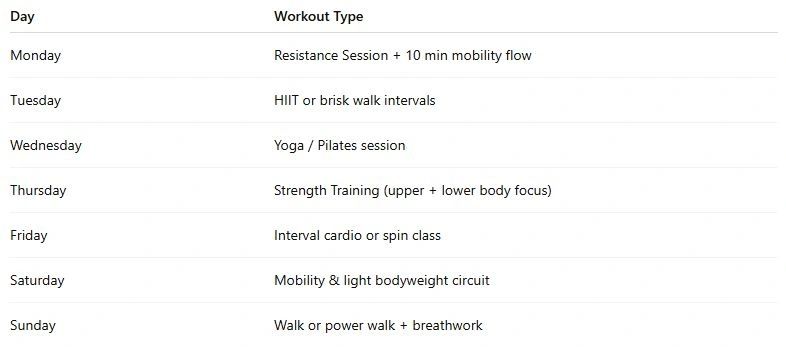
Mixing structure helps target hormone balance, bone health, mood regulation, and metabolic stability.
FAQ: Your Perimenopause Exercise Questions, Answered
Q: Will exercise make my hot flashes worse?
A: Research shows mixed results. Some studies find exercise reduces hot flash severity while others show no effect. Individual responses vary. Start conservatively with moderate-intensity exercise, track symptoms for 4-8 weeks, and adjust if symptoms worsen.
Q: Should I exercise differently based on where I am in my cycle?
A: Insufficient evidence supports cycle-based training modifications during perimenopause. Hormonal fluctuations are irregular during perimenopause unlike regular menstrual cycles, making systematic modifications difficult. Listen to daily energy levels rather than attempting precise cycle tracking.
Q: Can I start strength training for the first time during perimenopause?
A: Yes. Research shows beginners benefit equally from resistance training regardless of menopausal stage. Start with bodyweight exercises or light resistance, focus on form for 4-8 weeks, then progress load gradually under supervision if possible.
Q: How long before I notice symptom improvements from exercise?
A: Research interventions showing symptom improvements typically last 12+ weeks. Expect strength and mood improvements within 4-8 weeks, with bone density and body composition changes requiring 3-6 months. Individual symptom responses vary widely.
Q: Do I need hormone replacement therapy or will exercise be enough?
A: Exercise complements but doesn’t replace HRT for severe symptoms. Discuss HRT with physicians for debilitating symptoms. Exercise provides independent benefits for bone, muscle, metabolic health, and mood regardless of HRT status.
Prioritize Resistance Training, Track Your Response
Resistance training 2-3 times weekly produces consistent improvements in bone density, muscle strength, metabolic markers, and lean mass across all menopausal stages, though symptom-specific benefits vary individually.
Begin with twice-weekly full-body resistance sessions (45-60 minutes) at moderate intensity (70-80% maximum, 8-12 repetitions) combined with 150 minutes weekly moderate aerobic activity. Increase frequency and volume after 8-12 weeks if seeking maximum muscle and bone benefits.
For evidence-based guidance on structuring complete resistance training programs for women in midlife, explore our strength training fundamentals and progressive overload principles at BeeFit.ai. You can also check out our breakdown of protein requirements supporting muscle maintenance during hormonal transitions.
This article is for informational purposes only and is not a substitute for professional medical advice, diagnosis, or treatment. Always consult with a qualified healthcare provider before starting any new exercise or nutrition program.
Share :

