
Quick Take
- Stop waiting for motivation; true power is in action, especially when you don’t feel like it.
- Sustainable drive comes from running from a past self you despise (the “stick”), not just chasing rewards (the “carrot”).
- Neuroscience shows willpower grows only by doing things you genuinely hate, not just hard things you enjoy.
- Winning the internal war requires building a dominant “second voice” to defeat your default inner critic.
- Unshakable confidence is forged in solitude through “unseen work,” creating an internal reserve to draw from.
In a world saturated with life hacks and the endless search for a motivational spark, we’re conditioned to seek an easier path. We want the secret that will finally unlock our potential without the struggle. The message is clear: find your passion, get motivated, and the hard work will feel easy.
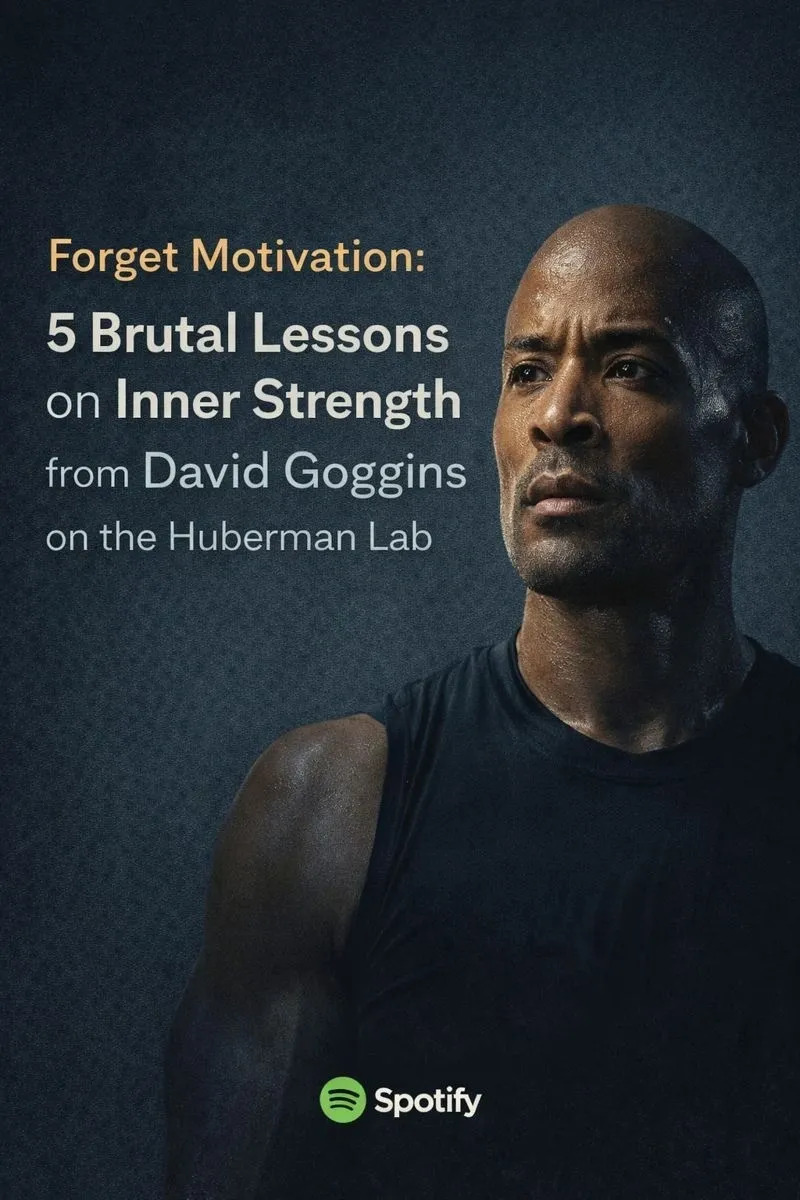
Then there’s the conversation between David Goggins and neuroscientist Andrew Huberman on the Huberman Lab podcast a session that serves as a radical demolition of this entire way of thinking. What makes their dialogue so potent isn’t just Goggins’s raw testimony; it’s the interplay between his brutal life experience and Huberman’s scientific frameworks. Huberman provides the neurological blueprint, and Goggins populates it with the visceral reality of a man who forged himself in fire.
Their core message is a direct assault on the comfort-seeking mindset: true, unshakable strength isn’t found in passion or positive thinking. It’s forged in the dark, by embracing the very friction we spend our lives trying to avoid. Here are the five most impactful lessons from their discussion that will change how you think about building inner strength.
1. Are You Addicted to Motivation?
Direct Answer: Yes, and it’s holding you hostage. Waiting for motivation or passion is a trap that makes your feelings the boss, guaranteeing a life of mediocrity. Power lies in decoupling action from emotion.
Explanation & Evidence:
Goggins argues that the modern pursuit of passion creates a false expectation that the path to growth should feel good. His reality is the opposite: the path is often a “nightmare,” and accepting this is the first step. He dismisses the words we cling to as flimsy excuses that keep us from the real work.
“There’s no fucking passion. There’s no fucking motivation… All those words are overused. They’re bullshit. It’s all bullshit. Just do.”
Analysis & Application:
This is a fundamental rewiring of your operating system. Stop asking “Do I feel like it?” Your goal is to build a identity of someone who acts regardless of feeling. Start by choosing one small, daily task you know you should do but often avoid (like a morning cold shower or a postponed chore). Do it immediately, without a single second of mental negotiation. This breaks the addiction to the right “feeling.”
2. Is Your Drive Built on a Carrot or a Stick?
Direct Answer: If you’re relying on rewards and positive visualization alone, your drive is fragile. The most sustainable engine is often the “stick” the relentless need to run from a past or potential self you fear becoming.
Explanation & Evidence:
Huberman introduces the classic psychological model of motivation: chasing a reward (carrot) versus avoiding a punishment (stick). Goggins confirms his engine is almost entirely the stick. He isn’t running toward a finish line of happiness; he’s running from the 300-pound, insecure man he used to be a ghost that haunts him to this day.
“That haunting is something that’s still there today because no matter how much you improve… it’s not permanent… Because once it turns off, I go right back to the David Goggins that is.”
Analysis & Application:
Reframe your goal-setting. Beyond chasing a promotion or a physique, define what you are running from. What version of yourself lazy, complacent, weak are you refusing to go back to? Write it down. Let that image fuel you when the “carrot” of future success feels too distant. The prize is surviving another day without becoming that person.
3. What’s the Only Real Workout for Willpower?
Direct Answer: Doing things you genuinely hate. Neuroscience reveals that the brain’s willpower center, the anterior mid-cingulate cortex (aMCC), grows only when you engage in tasks you are highly resistant to.
Explanation & Evidence:
This is the stunning scientific validation of Goggins’s philosophy. Huberman explains that the aMCC, a key region for tenacity and will, expands specifically through the friction of unwanted activity. A difficult task you enjoy does not produce the same growth.
“It was never about running. Why do you think I run? It’s the worst thing. I hate doing it more than anything. Hence the willpower.”
Analysis & Application:
Audit your “hard” routine. Is it filled with challenges you’ve learned to enjoy? To build real willpower, you must integrate a true “soul hate” task. It could be burpees, cold calls, or deep work on a tedious project. The key is the active resistance you feel. Do it not for the result, but for the neurological stressor. This is the only way to make your willpower bulletproof.
4. How Do You Win the War Inside Your Head?
Direct Answer: Not by silencing your inner critic, but by building a stronger, more dominant “second voice” to defeat it in daily battle. Your mind is a battlefield, not a meditation retreat.
Explanation & Evidence:
While many practices aim to quiet the mind, Goggins advocates for active, daily warfare. He describes the necessity of creating a second, commanding voice to combat the default voice of comfort and insecurity. Most people, he says, only have one voice telling them they’re not good enough.
“The winning voice is the second voice. They have one voice. And that’s just, “I’m a piece of shit” And that’s all they hear.”
Analysis & Application:
Stop trying to mute the negative self-talk. Instead, prepare for battle. When the first voice says “You can’t” your second voice must have a prepared, evidence-based counter: “I can, because I did it last Tuesday when I was more tired.” Cultivate this second voice by writing down past victories. Its strength comes from a resume of real proof, not empty affirmation.
5. Where is Unbreakable Confidence Actually Forged?
Direct Answer: In the solitude of the “unseen work”. True confidence is a private resume of suffering and accomplishment, an internal “medicine cabinet” you fill alone. When crisis hits, you draw from this reserve, not from external validation.
Explanation & Evidence:
Goggins argues that the work no one sees the early mornings, the extra reps, the personal trials builds an internal pharmacy of power. Huberman’s metaphor of the “medicine cabinet” perfectly captures this: you stock it drop by drop with every private victory. This creates a self-reliance so potent you need no external crutches.
“That is what motivates David Goggins is the unseen work. But everybody needs that pat on the back… I don’t need that shit. And neither do they.”
Analysis & Application:
Identify your external crutches: the pre-workout, the hype music, the accountability partner. Now, deliberately create a session where you remove them. Go for a run in silence. Train without caffeine. Tackle a project without telling anyone. These acts of solo fortitude stock your internal medicine cabinet. Build a supply so vast that your need for external motivation withers away.
Your Inner Strength Questions, Answered
Q: This sounds incredibly intense. Is it sustainable or a path to burnout?
A: It is a lifelong practice, not a short-term blast. The key is integrating these principles at a sustainable level. The “unwanted task” for willpower could be 10 minutes, not 2 hours. It’s about consistent engagement with friction, not total self-destruction. Recovery remains critical, but recovery is not comfort, it’s strategic replenishment for the next battle.
Q: How do I start if I’m not a former Navy SEAL?
A: You start exactly where Goggins did: with one small callous. Your first mission is to find the smallest, most immediate point of friction you’ve been avoiding a cluttered drawer, an uncomfortable email, a skipped workout and attack it right now. Do not plan to start tomorrow. The philosophy is built on the micro-battles you win in this moment.
Q: Doesn’t a “stick”-based mentality lead to a negative self-image?
A: It’s not about self-hatred; it’s about a ruthless commitment to not going backward. The fuel is a hatred of a former self or a potential lesser self, not your current self. It’s the difference between “I am worthless” (destructive) and “I will never be that version of me again” (propulsive). The second voice you build should be rooted in respect for your current effort.
Q: Can I use both “carrot” and “stick” motivation?
A: Absolutely. The lesson is that the “stick” is often the more reliable and powerful engine, especially when things get hard. Most people underutilize it. A robust system uses the vision of the future (carrot) as a guide, but the relentless rejection of backsliding (stick) as the daily fuel.
The Never-Ending Hunt
The central theme from Goggins and Huberman is that unbreakable strength is not discovered; it is built. It is not a gift found in comfort, but a skill forged in friction. It requires you to weaponize your discomfort, make peace with a permanent internal war, and find your power in the solitary, unseen work.
This path does not promise happiness—it promises ownership. You stop being a passenger waiting to feel motivated and become the driver who commands action. The journey doesn’t get easier. But, as Goggins says, through this relentless process, you are always found.
What is the one thing you’ve been negotiating with yourself about that you will simply do today? The door to the dungeon is open. The only question is if you will choose to turn the key.
Ready to build more mental resilience? Explore our foundational guides on habit formation and the science of consistency at BeeFit.ai.
This article is for informational purposes only and is not a substitute for professional psychological or medical advice.
Share :

