BeeFit: Fitness & Wellness

9 Ways to Make Running Fun Again (Beyond the Boring Jog)

Quick Take

  • Fartlek training (“speed play”) adds spontaneity to any run, using landmarks to mix sprints and jogs.
  • Hill and stair repeats build explosive power and strength, translating to faster, easier runs on flat ground.
  • Trail running reduces joint impact, improves proprioception, and boosts mental engagement with nature.
  • Gamification apps (like Zombies, Run!) can turn a solo slog into an immersive, narrative-driven workout.

If the thought of your next run feels like a chore, you’re not alone. The repetitive motion of steady-state jogging can dull motivation. But running is a skill with endless variations, each training different energy systems and muscles. The secret to falling back in love with it is to stop treating every run the same and start seeing it as a playground for fitness.

This guide offers nine tactical shifts from terrain to training style that will reignite your excitement, challenge your body in new ways, and remind you why you started running in the first place.

How Can Fartlek Training Make a Solo Run More Engaging?

It transforms your run into a game of speed and recovery based on your environment, removing the pressure of strict intervals.

Fartlek, Swedish for “speed play,” is unstructured interval training. Instead of watching a timer, you pick visual targets: sprint to the next mailbox, jog to the corner, then stride to the hilltop. This playful method keeps your mind actively engaged in the process of the run, not just the distance or time. It naturally improves both aerobic endurance and anaerobic speed without the mental grind of a track workout.

This approach is powerful because it marries the freedom of a jog with the intensity of a workout. It’s adaptable to any route and fitness level.

Your Application

On your next run, after a warm-up, play Fartlek. Choose five landmarks ahead of you. Sprint to the first, jog to the second, stride to the third, and so on. Let fun, not a watch, dictate the pace.

Why Are Hill Repeats Considered a “Shortcut” to Better Running?

They build muscular strength, power, and cardiovascular capacity more efficiently than flat running, making all your runs feel easier.

Running uphill forces you to powerfully drive your knees and push off the ground, recruiting more muscle fibers than flat running. This builds leg strength that directly translates to more speed and injury resilience. The steep incline also spikes your heart rate, providing a massive cardio boost in a short amount of time. What feels like a strength workout is also a potent metabolic conditioner.

The benefit is two-fold: you get stronger and fitter from one focused session. This efficiency is why elite runners never skip hill work. 

Your Application

Find a hill with a moderate incline that takes 45-90 seconds to run up. After a warm-up, run up hard, focusing on good form. Walk or jog down slowly for recovery. Start with 4-6 repeats once a week.

What Makes Trail Running Different from Road Running?

The uneven terrain demands constant micro-adjustments, improving balance, ankle strength, and proprioception, while the softer surface is gentler on joints.

On a trail, your brain and body are fully engaged. You’re navigating roots, rocks, and changes in elevation, which fires up stabilizing muscles often neglected on pavement. This not only reduces injury risk from repetitive motion but also turns your run into a full-body coordination drill. The mental focus required to place each foot is immersive, making time and distance fade into the background.

This is the antidote to monotony. Trail running is a dynamic puzzle for your body and mind, offering a profound sense of exploration that road running often lacks.

Your Application

Seek out a local park or greenway with dirt paths. Start with a short, well-marked trail. Slow your pace, focus on footing, and enjoy the scenery. Proper trail shoes with grip are recommended.

Can Listening to Something Other Than Music Actually Improve Your Run?

Yes. Engaging narratives (podcasts, audiobooks) or comedy can shift your brain’s focus from “effort monitoring” to cognitive engagement, reducing perceived exertion.

Music can sometimes tie your pace to a specific beat. A compelling story or podcast, however, draws you into a different world. This cognitive distraction can make the run feel shorter and less strenuous, as your brain is occupied with processing language and narrative rather than fixating on fatigue or mileage. Laughter from a comedy special can also ease tension and improve your mood, making the run more enjoyable.

This strategy is about managing your mind. A distracted mind is a happy runner, and a happy runner is a consistent runner.

Your Application

Download a gripping true-crime podcast or an audiobook you’ve been meaning to read. Save it exclusively for your runs to create a positive association.

FAQ: Your Running Variety Questions, Answered

Q: I’m a beginner. Which of these is the best place to start?
A: Begin with Fartlek and Podcasts. Fartlek introduces speed in a low-pressure way, and podcasts are an easy swap from music. Avoid intense hill repeats or technical trails until you have a solid base (4-6 weeks of consistent running) to prevent injury.

Q: How often should I incorporate these “fun runs” versus my regular runs?
A: Follow the 80/20 rule. Roughly 80% of your weekly mileage should be easy, conversational-paced running. Use 20% for these varied, fun workouts (e.g., one hill session and one Fartlek or trail run per week). This balances stress and recovery while keeping things fresh.

Q: Do I need special gear for trail running?
A: The most important investment is trail-running shoes. They have aggressive tread for grip and often feature rock plates to protect your feet. Otherwise, moisture-wicking clothing and a way to carry water (like a hydration vest) are useful for longer trails.

Q: Can gamification apps really make me run faster?
A: Yes, through behavioral psychology. Apps like Zombies, Run! use audio narratives where you must sprint to escape “zombie chases.” This forces interval training in a context that feels like play, not work. The urgency can help you tap into speeds you might not push to on your own.

Q: What if I hate sprinting or hills?
A: You don’t have to do what you hate. Focus on the variations that appeal to you. If you dislike sprinting, explore trails or hiking. If hills are the enemy, try stair running in a stadium; the defined steps can feel more manageable. The goal is to find your version of fun.

Conclusion

Running doesn’t have a boredom problem; it has a creativity problem. The simple act of putting one foot in front of the other is a canvas for endless variation. By periodically shifting your terrain, your pace, your auditory input, and even the rules of the workout, you transform running from a repetitive task into a dynamic practice that challenges your body and delights your mind.

Reignite your passion by choosing one new method from this list for your next run. You might just discover that the run you’ve been dreading becomes the highlight of your day.

Ready to structure these fun runs into a smart training plan? Build your personalized running program with our workout builder at BeeFit.ai.

This article is for informational purposes only. It is not a substitute for professional running coaching or medical advice. Always consult your physician before beginning a new exercise regimen, especially when incorporating high-intensity elements like sprinting or hill training. Increase trail difficulty and mileage gradually to prevent injury.


Calisthenics 101: Build Strength Anywhere with Your Bodyweight

Quick Take

  • Calisthenics builds functional strength, mobility, and endurance using only your bodyweight, making it one of the most accessible and cost-effective forms of fitness.
  • It is highly adaptable for all levels, from beginners doing knee push-ups to advanced athletes performing muscle-ups and handstands.
  • Success hinges on mastering foundational movements like push-ups, squats, and planks with perfect form before progressing.
  • A consistent, progressive routine built around compound movements delivers full-body results without any gym equipment.

For centuries, the most powerful fitness tool has been readily available: your own body. Calisthenics, the art of bodyweight training is experiencing a modern renaissance, and for good reason. It cuts through the noise of expensive memberships and complex equipment, offering a direct path to formidable strength, impressive control, and resilient health.

But is this minimalist approach truly effective for building a strong physique? Can beginners really start with zero equipment? This guide moves beyond the basics to explore the underlying principles of calisthenics, who benefits most, and provides a science-backed blueprint to start your journey from foundational movements to advanced skills.

Is Calisthenics Effective for Building Real Strength?

Direct Answer: Yes, profoundly. Calisthenics builds authentic, functional strength and muscle hypertrophy by leveraging progressive overload through exercise complexity, leverage, and volume, not just external weight.

Explanation & Evidence:
The principle of strength adaptation is simple: muscles must be challenged beyond their current capacity. Calisthenics achieves this not by adding plates, but by manipulating body mechanics. Moving from a knee push-up to a full push-up, then to a deficit push-up or planche progression, systematically increases the resistance your muscles must overcome.

This method develops what athletes call “kinesthetic awareness”, a superior sense of body control, joint stability, and coordinated strength that often surpasses what is developed on machines. It’s the foundation of the expert-crafted, adaptable training philosophy you find at BeeFit.ai.

Analysis & Application

The effectiveness lies in the progression ladder. You don’t just do “more squats”; you advance from bodyweight squats to pistol squat progressions, dramatically increasing the demand on your legs and core. This makes calisthenics a complete strength-building system.

Who is the Ideal Candidate for a Bodyweight Training Style?

Direct Answer: Calisthenics is uniquely suited for beginners seeking a safe foundation, travelers, home exercisers, and anyone valuing functional, practical strength over isolated muscle size. Its scalability makes it universally appropriate.

Explanation & Evidence:
The accessibility is unmatched. A beginner can start with wall push-ups and box squats, while an advanced athlete works on one-arm pull-ups and handstand push-ups. Both are following the same principles, just at different points on the continuum. This eliminates barriers like cost, location, and intimidation.

Analysis & Application

Identify your “why.” If your goals are joint health, mastering your body’s movement, training with minimal time or equipment, or supplementing other sports, calisthenics is ideal. It’s less optimal for those solely pursuing maximum muscle size (hypertrophy) in specific body parts, where heavy external loading is more efficient.

What Does a Scientifically-Sound Beginner Plan Look Like?

Direct Answer: A proper beginner plan focuses on movement quality, not quantity, structured around 2-3 full-body sessions per week that emphasize the fundamental movement patterns: push, pull, squat, hinge, and brace.

Explanation & Evidence:
Jumping into advanced moves without a foundation leads to injury and frustration. The initial neurological adaptation teaching your brain to fire the right muscles is more critical than fatigue. A study in the Journal of Strength and Conditioning Research emphasizes that novice trainees see the most strength gains from practicing movement patterns with sub-maximal effort to ingrain proper technique.

Analysis & Application

Follow this foundational blueprint for your first month:

  • Frequency: 3 sessions per week (e.g., Mon, Wed, Fri).
  • Structure: 3 rounds of the following circuit, resting 60-90 seconds between rounds.
    • Push-Ups (or Knee Push-Ups): 5-10 reps
    • Bodyweight Squats: 10-15 reps
    • Inverted Rows (using a sturdy table) or Banded Pull-Aparts: 5-10 reps
    • Plank Hold: 20-40 seconds
  • Progression: Each week, aim to add 1-2 reps to each exercise or hold your plank 5 seconds longer.

This full-body approach ensures balanced development. For a personalized plan that adapts this structure to your exact starting level and goals, explore the tools at BeeFit.ai.

How Do You Safely Progress to Advanced Moves?

Direct Answer: Safe progression follows the “regress to progress” rule: master the current variation with perfect form, then introduce the next progression through techniques like leverage changes, isometric holds, or adding reps—never through momentum or poor form.

Explanation & Evidence:
Advanced calisthenics skills are a display of strength-to-weight ratio, joint integrity, and neuromuscular control. Rushing this process strains connective tissues (tendons and ligaments) that adapt much slower than muscle tissue.

Analysis & Application

Use this progression pathway for two key movements:

  • Push-Up Path: Wall Push-Up → Incline Push-Up → Knee Push-Up → Full Push-Up → Diamond Push-Up → Archer Push-Up.
  • Pull-Up Path: Scapular Hangs → Dead Hangs → Flexed-Arm Hangs → Negative Pull-Ups (slow lower) → Band-Assisted Pull-Ups → Full Pull-Up.

Spend at least 2-4 weeks dominating each step before moving on. This patient, technical focus is the fastest route to true mastery and injury-free training.

Your Calisthenics Questions, Answered

Q: I can’t do a single pull-up. Where do I start?
A: This is very common. Start by building your back and grip strength with bodyweight rows. Set a bar at waist height, lie underneath, and pull your chest to the bar. Also, practice negative pull-ups: use a box to jump to the top position, and lower yourself down as slowly as possible (aim for 5+ seconds).

Q: How can I build muscle (hypertrophy) with just bodyweight?
A: Focus on time under tension and challenging variations. Slow your reps down (e.g., 3 seconds down, 1 second up), add pauses at the hardest point, and reduce leverage (e.g., feet-elevated push-ups). Once you can perform 12-15 clean reps of an exercise, it’s time to move to a harder progression to continue building muscle.

Q: Do I need to train abs separately with calisthenics?
A: Your core is engaged as a stabilizer in almost every compound calisthenics move. However, for direct development, add isometric holds like L-sits, hollow body holds, and dynamic movements like hanging knee raises 2-3 times per week after your main workout.

Q: What’s the most common mistake beginners make?
A: Neglecting the “pull” movements. It’s easy to focus on push-ups and squats, but a balance of pushing and pulling is vital for shoulder health and posture. Always pair a push exercise with a pull exercise in your routine.

Calisthenics is more than a workout trend; it’s a return to fundamental, intelligent strength training. By respecting the progression ladder and prioritizing movement quality, you unlock the ability to build a capable, resilient body anywhere in the world. The journey from your first solid push-up to your first controlled pull-up is one of the most rewarding experiences in fitness.

Ready to get a personalized calisthenics roadmap that adapts to your progress? Start building your bodyweight mastery with a free, tailored plan from BeeFit.ai.

This article is for informational purposes only and is not a substitute for professional medical advice. Always consult with a healthcare provider before beginning any new exercise program.

HIIT vs. LISS: Which Cardio Is Best for Fat Loss?

Quick Take

  • HIIT is more time-efficient, burning significant calories during and after the workout via the EPOC (afterburn) effect.
  • LISS is sustainable for longer durations, making it ideal for beginners and those needing low-impact, joint-friendly cardio.
  • For pure fat loss, calorie deficit is king; HIIT burns more calories per minute, but LISS can be done for longer, potentially equaling total calorie burn.
  • The optimal approach for most is a blend: using HIIT 1-2x weekly for metabolic boost and LISS for active recovery and baseline calorie expenditure.

When it comes to cardio workouts, two popular methods often dominate the conversation: High-Intensity Interval Training (HIIT) and Low-Intensity Steady-State (LISS). Both have their benefits, but which one is more effective for fat loss?

The answer depends on your fitness level, preferences, and lifestyle. Let’s explore the pros and cons of each and how to determine the best option for your goals.

What Is HIIT?

High-Intensity Interval Training (HIIT) consists of short bursts of intense exercise followed by periods of low-intensity recovery or rest.

A typical HIIT session might include:

  • 30 seconds of sprinting
  • 60 seconds of walking
  • Repeated for 15–30 minutes

This alternating pattern pushes your body to work at maximum capacity, leading to an increased calorie burn in a shorter time frame. HIIT workouts are known for their ability to boost metabolism, improve cardiovascular fitness, and accelerate fat loss.

Benefits of HIIT for Fat Loss

  1. Burns More Calories in Less Time: HIIT sessions are shorter but highly effective in torching calories, both during and after the workout.
  2. Boosts Metabolism: HIIT triggers the “afterburn effect” (excess post-exercise oxygen consumption or EPOC), meaning your body continues to burn calories even after the workout is over (American College of Sports Medicine).
  3. Preserves Muscle Mass: It combines cardiovascular benefits with strength training, helping maintain lean muscle while losing fat.
  4. Time-Efficient: Perfect for those with busy schedules, as sessions typically last 20–30 minutes.

What Is LISS?

Low-Intensity Steady-State (LISS) involves maintaining a consistent, moderate pace of exercise for a longer duration. Think of brisk walking, cycling, or using an elliptical machine for 30–60 minutes.

Benefits of LISS for Fat Loss

  1. Burns Fat as Fuel: LISS primarily uses fat as its energy source, making it ideal for steady fat-burning during the workout (Australian Institute of Fitness).
  2. Easier on the Joints: Its low-impact nature makes it a safer option for beginners, those recovering from injuries, or individuals with joint issues.
  3. Improves Endurance: LISS builds cardiovascular stamina and aerobic capacity over time.
  4. Accessible to All Levels: It’s less intimidating for beginners and easier to sustain over longer periods.

HIIT vs. LISS: Which Is More Effective for Fat Loss?

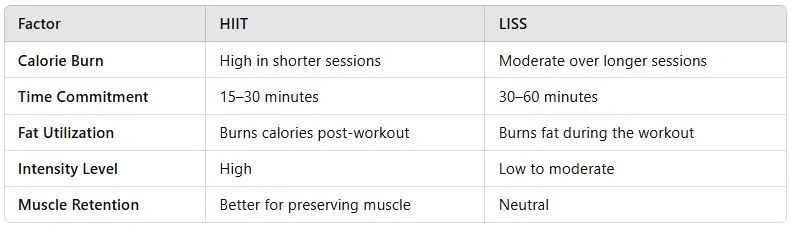
The key to fat loss lies in creating a calorie deficit—burning more calories than you consume. Both HIIT and LISS can help you achieve this, but they do so in different ways:

Choosing the Best Cardio for You

  1. If You’re Short on Time: Choose HIIT for quick, intense workouts that maximize calorie burn.
  2. If You’re a Beginner: Start with LISS to build endurance and ease into a routine.
  3. If You Want Variety: Mix both! Alternate between HIIT and LISS throughout the week to keep your routine fresh and effective.
  4. If You’re Focused on Muscle Retention: Incorporate HIIT alongside strength training.

A Sample Weekly Plan

Monday: 20-Minute HIIT Session (e.g., sprints and walking intervals).
Tuesday: 45-Minute LISS Session (e.g., brisk walking or cycling).
Thursday: 20-Minute HIIT Session (e.g., jump squats and push-ups).
Saturday: 60-Minute LISS Session (e.g., steady jog or swimming). 

FAQ: Your HIIT vs. LISS Questions, Answered

Q: Which one burns more belly fat?
A: Neither spot-reduces fat. Fat loss occurs systemically. However, HIIT may be more effective at reducing visceral fat (the deep belly fat linked to health risks) due to its intense hormonal and metabolic impact. The best method for losing belly fat is the one you can adhere to consistently while maintaining a calorie deficit.

Q: Is it true that LISS burns a higher percentage of fat during the workout?
A: Yes, but this is often misunderstood. At lower intensities, your body uses a higher percentage of fat for fuel. However, at higher intensities (HIIT), you burn more total calories and more fat calories overall in the same timeframe, even if the percentage from fat is lower. Total calorie burn is more important for fat loss than the fuel source percentage during exercise.

Q: Can I do HIIT every day?
A: No. HIIT places high stress on your nervous system and muscles. Doing it daily leads to overtraining, injury, and burnout. Limit intense HIIT to 2-3 non-consecutive days per week. On other days, opt for LISS, strength training, or rest.

Q: I’m new to exercise. Should I start with HIIT or LISS?
A: Start with LISS. Build a base of cardiovascular fitness, joint resilience, and the habit of consistent exercise for 4-6 weeks. Then, carefully introduce short, low-impact HIIT intervals (e.g., 30 sec fast walk/60 sec slow walk) once a week.

Q: How do I know if I’m in the right intensity zone for each?
A: For LISS, you should be able to hold a conversation comfortably (the “talk test”). For HIIT, your work intervals should feel like an 8-9 out of 10 effort, where speaking more than a word or two is impossible. Using heart rate zones (LISS: 60-70% max HR; HIIT peaks: 80-90%+) is more precise.

The Bottom Line

Both HIIT and LISS are effective for fat loss, but the best choice depends on your goals, preferences, and lifestyle. By incorporating a mix of both, you can enjoy the benefits of variety, stay motivated, and optimize your results.

This article is based on my personal experiences and opinions. It is not intended as medical advice or a substitute for professional guidance. Always consult a qualified professional or healthcare provider for personalized advice regarding your health and wellness.

10 Signs of Overtraining and How to Recover

Quick Take

  • Overtraining is a state of chronic fatigue and performance decline caused by inadequate recovery, not just being tired after a hard workout.
  • Key physiological signs include a persistently elevated resting heart rate, unrelenting muscle soreness, and a weakened immune system leading to frequent illness.
  • Mental and emotional symptoms like loss of motivation, mood swings, and sleep disturbances are critical indicators of hormonal and nervous system imbalance.
  • Recovery requires strategic rest, nutritional support, and a reduced training load, with structured guidance from platforms like BeeFit.ai to prevent recurrence.

Exercise is essential for health, but the line between rigorous training and harmful overtraining is thinner than many realize. Overtraining syndrome occurs when the volume and intensity of exercise exceed your body’s capacity to recover, leading to a cascade of physical, emotional, and performance setbacks. Unlike normal fatigue, it’s a persistent state where more work leads to diminishing returns and potential harm.

Recognizing the early warnings is crucial for any dedicated individual. This guide details the ten most critical signs, backed by physiology, and provides a clear recovery roadmap to help you restore balance, protect your progress, and build a smarter, more sustainable approach to fitness.

How Do You Differentiate Overtraining from Normal Fatigue?

Direct Answer: Overtraining is characterized by a persistent decline in performance and well-being despite rest, whereas normal fatigue resolves with a day or two of recovery. It represents a systemic breakdown in your body’s adaptive capacity.

Explanation & Evidence
Normal training fatigue is a local, acute response that leads to supercompensation and growth. Overtraining is a chronic, systemic maladaptation of the neuroendocrine system, often involving dysregulation of cortisol and other stress hormones.

The Sleep Foundation notes that persistent exhaustion despite adequate sleep is a hallmark sign, indicating the body’s recovery systems are overwhelmed and cannot restore homeostasis.

Analysis & Application

Listen to trends, not just bad days. If your energy, mood, and performance are on a downward slope for more than two weeks despite attempted rest, it’s likely overtraining. This is where intelligent tracking and structured programming become invaluable to avoid the guesswork that leads to burnout.

What Are the Key Physical & Physiological Red Flags?

Direct Answer: Your body sends unambiguous signals through performance plateaus or regression, unshakable muscle soreness, an elevated resting heart rate (RHR), and a compromised immune system.

Explanation & Evidence
These signs indicate your central nervous system is fatigued, muscle tissue isn’t repairing, and your body is in a prolonged stress state.

  • Elevated RHR: A sustained increase of 5-10 beats per minute upon waking suggests your sympathetic (“fight or flight”) nervous system is chronically activated.
  • Frequent Illness: Intense, prolonged exercise increases cortisol and adrenaline, which can suppress immune cell function, making you more susceptible to infection.

Analysis & Application

Monitor your waking heart rate. Use a fitness tracker or manually check it each morning before getting out of bed. A consistent elevation is a clear cue to pull back. Similarly, view recurring colds or injuries not as bad luck, but as direct feedback that your training load is too high.

How Does Overtraining Manifest Mentally and Emotionally?

Direct Answer: Overtraining directly impacts brain chemistry, leading to sleep disturbances, loss of motivation, irritability, and feelings of depression—symptoms often mistaken for simple burnout or life stress.

Explanation & Evidence
The hormonal imbalance from chronic physical stress (high cortisol, potential drops in serotonin and dopamine) affects the same neurological pathways involved in mood regulation. The mental exhaustion is not a lack of willpower but a biochemical state.

Analysis & Application

Dreading workouts you once loved is a major red flag. Exercise should generally leave you feeling energized and positive. If it consistently leaves you drained, irritable, or anxious, your regimen needs immediate adjustment. This is a core reason why sustainable fitness requires balancing stress with recovery, a principle central to the expert-crafted plans at BeeFit.ai.

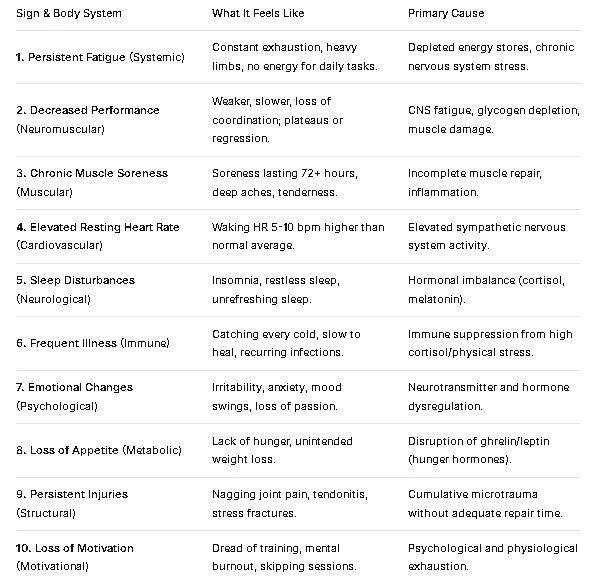
The 10 Critical Signs: A Diagnostic Checklist

Use this table to assess your current state. The presence of multiple signs strongly indicates overtraining.

What Is the Scientifically-Backed Recovery Protocol?

Direct Answer: Effective recovery from overtraining requires a multifaceted approach focused on stress reduction, nutritional support, and strategic activity—not just complete inactivity.

Explanation & Evidence
Recovery must address the root cause: systemic overload. A study in the Journal of Strength and Conditioning Research emphasizes that recovery is an active process involving managed stress, not just passive rest.

Analysis & Application

Follow this structured protocol:

  1. Take a Strategic Break: 3-7 days of complete rest or very gentle movement (walking, stretching).
  2. Prioritize Sleep & Nutrition: Aim for 8-10 hours of sleep. Focus on protein for repair, complex carbs to replenish glycogen, and healthy fats for hormone production.
  3. Reintroduce Activity Gradually: Start with 30-50% of your previous volume and intensity, focusing on technique and enjoyment.
  4. Seek Professional Guidance: A coach or physiotherapist can provide an objective assessment and a structured return-to-training plan. For a science-backed, balanced approach to rebuilding your fitness sustainably, explore the tailored resources available at BeeFit.ai.

Your Overtraining Recovery Questions, Answered

Q: How long does it take to recover from overtraining?
A: Recovery time varies widely based on severity. Mild cases may resolve in 1-2 weeks with proper rest. More severe, long-term overtraining can require several weeks to months of reduced activity. Patience is critical; rushing back guarantees relapse.

Q: Can I do any activity during recovery?
A: Yes, and you should. Active recovery like walking, leisurely cycling, swimming, or gentle yoga promotes blood flow and aids healing without adding significant stress. The key is keeping intensity very low and avoiding the exercises that led to overtraining.

Q: How can I prevent overtraining in the future?
A: Implement periodization—structuring your training into cycles with built-in deload weeks. Track objective metrics (performance, RHR, sleep quality) alongside subjective feelings. Most importantly, view rest and nutrition as non-negotiable components of the training program, not as interruptions to it.

Q: When should I see a doctor?
A: If symptoms are severe, include heart palpitations, significant depression, or do not improve after 2-3 weeks of dedicated rest and self-care. Consult a healthcare professional to rule out other medical conditions like thyroid issues, anemia, or clinical depression.

Overtraining is not a badge of honor; it is a sign that your methodology needs refinement. By learning to heed your body’s warnings—the elevated heart rate, the lingering soreness, the stolen motivation—you graduate from simply working hard to training smart. True fitness is built on the foundation of recovery. Embrace it, and you’ll build not just a stronger body, but a more resilient and sustainable practice.

For a personalized plan that balances intense effort with essential recovery, discover your free, expert-crafted fitness strategy at BeeFit.ai.

This article is for informational purposes only and is not a substitute for professional medical advice, diagnosis, or treatment. Always seek the advice of your physician or other qualified health provider with any questions regarding a medical condition.

Your 4-Week Blueprint to a Stronger, Fitter You

Quick Take

  • structured 4-week full-body plan builds strength, endurance, and habit by focusing on form before intensity.
  • Strategic progression is key: Week 1 masters movement; Weeks 2-4 systematically increase reps, load, and complexity.
  • Foundational habits—hydration, warm-ups, cooldowns—are non-negotiable for performance, recovery, and injury prevention.
  • Consistency with compound movements like squats and rows yields faster, more balanced results than isolated exercises.

Starting a fitness journey can feel overwhelming. Where do you begin? How do you progress without getting hurt or burned out? The answer isn’t found in a random collection of exercises, but in a structured, progressive plan.

This 4-week blueprint is designed using fundamental exercise science principles. It moves you from learning proper movement patterns to building genuine strength and endurance, establishing a sustainable fitness habit. Whether at home or in the gym, this plan provides the clear roadmap beginners need to build confidence and see real results.

Why Is a Full-Body, Progressive Plan the Best Start?

Direct Answer: A full-body plan focused on compound movements maximizes efficiency and foundational strength, while weekly progression ensures continuous adaptation, preventing plateaus and building a resilient, balanced physique.

Explanation & Evidence
For beginners, the goal is to teach the body fundamental movement patterns; squatting, pushing, pulling, hinging, and bracing. Full-body workouts that emphasize these compounds stimulate more muscle per session, boost metabolism, and improve functional fitness faster than split routines.

The principle of progressive overload gradually increasing stress on the body is the engine of all fitness improvement. A structured plan applies this systematically, which is exactly the kind of science-backed programming BeeFit.ai uses to build effective, free workout plans for all levels.

Analysis & Application

This plan applies overload intelligently: first through more reps and sets (Week 2), then via exercise difficulty (Week 3), and finally with increased volume and endurance (Week 4). This methodical approach builds skill, tissue resilience, and strength simultaneously, laying a bulletproof foundation.

What Are the Non-Negotiable Habits for Success and Safety?

Direct Answer: Success hinges on hydration, proper warm-ups, and dedicated cooldowns. These are not extras; they are essential components that directly impact performance, recovery, and injury risk.

Explanation & Evidence

  • Hydration: Water is crucial for nutrient transport, joint lubrication, and temperature regulation. Even mild dehydration can significantly impair strength and focus.
  • Dynamic Warm-Up: Light activity and dynamic stretches increase blood flow, muscle temperature, and joint mobility, preparing your body for the demands of the workout.
  • Cool-Down: Slowing your heart rate gradually and incorporating static stretching aids in recovery, reduces muscle stiffness, and improves flexibility over time.

Analysis & Application

Treat these habits as part of the workout itself. Schedule your water intake, and dedicate 5-10 minutes before and after each session to warm-up and cool-down. This discipline transforms exercise from a sporadic task into a complete, respectful practice for your body.

Your 4-Week Progressive Training Blueprint

Direct Answer: This blueprint is your day-by-day guide. Focus on mastering the form of each movement before adding weight or speed. Consistency with quality execution is your primary goal.

Analysis & Application

Week 1: Master the Movement

Goal: Learn patterns, connect mind to muscle.

  • Bodyweight Squats: 2×12 reps. Focus on depth and knee alignment.
  • Push-Ups (modified ok): 2×8-10 reps. Keep core tight, don’t sag.
  • Bent-Over Rows: 2×10 reps. Squeeze shoulder blades together.
  • Glute Bridges: 2×12 reps. Drive through heels, squeeze glutes at the top.
  • Plank Hold: 2×15-20 seconds. Maintain a straight line from head to heels.

Week 2: Build Work Capacity

Goal: Increase volume, build muscular endurance.

  • Increase all exercises to 3 sets.
  • Add 2-3 reps to each set (e.g., Squats: 3×15).
  • Hold plank for 20-30 seconds.

Week 3: Introduce New Challenges

Goal: Increase intensity via exercise variations.

  • Squats: Add light dumbbells (3×15).
  • Push-Ups: Move to full or incline push-ups (3×12-15).
  • Rows: Switch to single-arm rows (3×10/arm).
  • Glute Bridges: Add a 5-second hold at the top.
  • Plank: Add shoulder taps (3x20s).

Week 4: Push for Endurance

Goal: Solidify gains, increase time under tension.

  • Weighted Squats: 3×18 reps.
  • Push-Ups: 3×12-15 reps.
  • Single-Arm Rows: 3×12 reps/arm.
  • Glute Bridge March: 3×16 reps (alternating legs).
  • Plank w/ Taps: 3×30 seconds.

How Do You Fuel and Listen to Your Body for Optimal Results?

Direct Answer: View nutrition as foundational support, not an afterthought. Pair carbohydrates with protein 1-2 hours pre-workout for energy, and prioritize listening to your body’s signals to differentiate between good effort and harmful pain.

Explanation & Evidence
Your body needs fuel to perform and repair. A pre-workout meal with carbs (energy) and protein (muscle repair) optimizes session quality and recovery. Equally crucial is body awareness: “good” muscular burn is typical; sharp, joint, or radiating pain is a warning to stop.

Analysis & Application

Keep pre-workout meals simple: Greek yogurt with fruit, or toast with peanut butter. During workouts, distinguish between fatigue (you can push through with good form) and pain (you must stop). This skill is vital for long-term progress and is a key focus of the expert guidance available through BeeFit.ai, which helps you adapt plans based on your feedback.

Your Beginner Plan Questions, Answered

Q: What if I can’t complete all the reps or sets?
A: This is completely normal. Perform as many high-quality reps as you can. If you fail on the 10th rep of a 12-rep set, you’ve still done effective work. Note it down, and aim to match or exceed it next time. Consistency, not perfection, drives progress.

Q: Do I need to work out every day?
A: No. Rest days are when your body strengthens. Follow this plan 3-4 days per week (e.g., Monday, Wednesday, Friday). On off days, focus on walking, stretching, or other gentle activity to promote recovery.

Q: What should I do after Week 4?
A: This is the perfect time to level up. You can repeat Week 4 with slightly heavier weights, or seek a more advanced, personalized plan. Platforms like BeeFit.ai are ideal for this next step, offering free, customized routines that adapt to your new strength levels and goals.

Q: I feel sore after every workout. Is this okay?
A: Mild to moderate muscle soreness (DOMS) 24-48 hours after a new or intense workout is normal. Severe pain, sore joints, or lingering pain is not. Manage normal soreness with light movement, hydration, and proper cool-downs.

Completing this 4-week plan is a significant achievement. You will have built strength, endurance, and—most importantly—the confidence that comes from following through on a commitment to yourself. Fitness is a lifelong journey, and you’ve just laid the strongest possible foundation.

Ready to build your next personalized training phase? Continue your journey with a free, adaptive plan designed just for you at BeeFit.ai.

This article is for informational purposes only and is not a substitute for professional medical advice. Always consult with a healthcare provider before beginning any new exercise program.

The Benefits of Walking 10,000 Steps a Day

Quick Take

  • The 10,000-step goal originated as a Japanese pedometer marketing slogan, but research confirms that increasing daily steps significantly improves health.
  • Walking this distance typically burns 300-500 calories and is a sustainable, low-impact tool for weight management.
  • Benefits extend beyond fitness: it reduces stress, improves sleep, and enhances blood sugar regulation.
  • The exact number isn’t universal; studies show 7,000-8,000 steps can deliver most longevity benefits, with diminishing returns beyond 10,000.

Walking is one of the simplest, most accessible forms of exercise, and the goal of taking 10,000 steps a day has become a popular benchmark for fitness and overall health. While the number itself isn’t a one-size-fits-all target, walking more each day offers undeniable health benefits for your body, mind, and long-term well-being.

Here’s a closer look at why walking 10,000 steps a day is beneficial and how you can incorporate this habit into your daily routine.

Why 10,000 Steps?

The 10,000-step goal originated in Japan during the 1960s as part of a marketing campaign for a pedometer. Over time, it has been embraced globally as a symbol of daily activity. While not universally backed as a magic number, research shows that increasing your step count significantly improves health outcomes.

Health Benefits of Walking 10,000 Steps a Day

  1. Improves Cardiovascular Health
    Walking increases your heart rate, improving circulation and reducing the risk of heart disease. Studies suggest that regular walking lowers blood pressure and cholesterol levels (American Heart Association).
  2. Supports Weight Management
    Walking burns calories, making it an effective tool for maintaining or losing weight. A 10,000-step walk burns approximately 300–500 calories, depending on your pace, weight, and terrain.
  3. Boosts Mental Health
    Walking has been shown to reduce stress, anxiety, and depression. It releases endorphins, the body’s natural mood boosters, and provides time to clear your mind (NIH).
  4. Enhances Muscular and Joint Strength
    Regular walking strengthens the muscles in your legs, hips, and core while improving joint flexibility. It’s a low-impact way to stay active and reduce the risk of conditions like arthritis.
  5. Improves Metabolic Health
    Walking helps regulate blood sugar levels and improves insulin sensitivity, making it a beneficial activity for managing or preventing type 2 diabetes (CDC).
  6. Increases Longevity
    Studies show that walking regularly reduces the risk of premature death by improving overall health and reducing the likelihood of chronic diseases.
  7. Encourages Better Sleep
    Walking promotes better sleep quality by reducing stress and physical restlessness. A brisk walk during the day can help regulate your sleep cycle.

How to Reach 10,000 Steps a Day

  1. Track Your Steps
    Use a fitness tracker, smartwatch, or smartphone app to monitor your daily steps. BeeFit AI Calculator can help you set realistic goals and track your progress.
  2. Incorporate Walking Into Your Day
    • Take the stairs instead of the elevator.
    • Park farther away from your destination.
    • Schedule short walking breaks during your workday.
  3. Make It Social
    Walk with a friend, family member, or coworker to make it more enjoyable and hold each other accountable.
  4. Walk During Errands
    Combine exercise with productivity by walking to the store, post office, or nearby locations instead of driving.
  5. Add a Daily Walk to Your Routine
    Aim for a 30-minute walk in the morning, during lunch, or after dinner. Breaking your steps into smaller chunks makes the goal more achievable.
  6. Challenge Yourself
    Gradually increase your pace or add inclines to burn more calories and boost your cardiovascular fitness.

Is 10,000 Steps Necessary for Everyone?

Not everyone needs to hit exactly 10,000 steps a day. Depending on your age, health, and activity level, you may benefit from fewer or more steps. A study published in JAMA Internal Medicine found that walking as little as 7,000 steps daily still significantly reduces the risk of mortality (PubMed).

The key takeaway? Focus on increasing your daily activity level in a way that works for you. 

FAQ: Your 10,000 Steps Questions, Answered

Q: Do I have to walk 10,000 steps all at once?
A: No. Steps accumulated throughout the day are just as beneficial for your health. Breaking it into smaller walks like a morning stroll, lunchtime walk, and after-dinner walk is more sustainable and easier to integrate into a busy schedule.

Q: Is walking 10,000 steps enough exercise for the day?
A: It’s an excellent foundation for general health, but it’s not a complete fitness program. For optimal health, you should also include 2-3 days of strength training to maintain muscle and bone density, and consider more vigorous cardio (like brisk walking or jogging within those steps) for cardiovascular fitness.

Q: How fast do I need to walk for it to “count”?
A: Any pace is beneficial, but for cardiovascular fitness, aim for a “brisk” pace where you can talk but not sing (about 3-4 mph). A leisurely stroll is still great for mental health and calorie burn, but moderate-intensity walking provides greater heart and metabolic benefits.

Q: What if I have a sedentary job? How can I possibly hit 10k?
A: Get creative with “step snacks.” Set a timer to walk for 5-10 minutes every hour. Take walking meetings, pace during phone calls, or do a loop around your office/building. These small bursts add up dramatically over a workday.

Q: I heard 7,000 steps is enough. Should I aim lower?
A: The 7,000-8,000 step range is strongly linked to reduced mortality risk. If 10,000 feels daunting, start with 7,000 as your target. The most important thing is to increase from your current baseline. If you currently take 3,000 steps, getting to 5,000 is a massive win. Consistency with a slightly lower number is better than burnout chasing 10,000.

The Bottom Line

Walking 10,000 steps a day may not be a magic number, but it’s a powerful way to improve your physical and mental health. By making small, consistent efforts to increase your daily activity, you’ll enjoy the benefits of better fitness, reduced stress, and improved well-being.

This article is based on my personal experiences and opinions. It is not intended as medical advice or a substitute for professional guidance. Always consult a qualified professional or healthcare provider for personalized advice regarding your health and wellness.